
The Economics of Air Ambulance: Rethinking €4,500 an Hour
Helicopter emergency medical services are one of medicine's clearest success stories and one of its most awkward line items. A €9.2 billion global industry, growing at over 7% a year, funds itself through a mixture of strained public budgets, charity fundraising and patient bills that can be ruinous. The uncomfortable truth: the costs are not a market condition. They are a design inheritance.
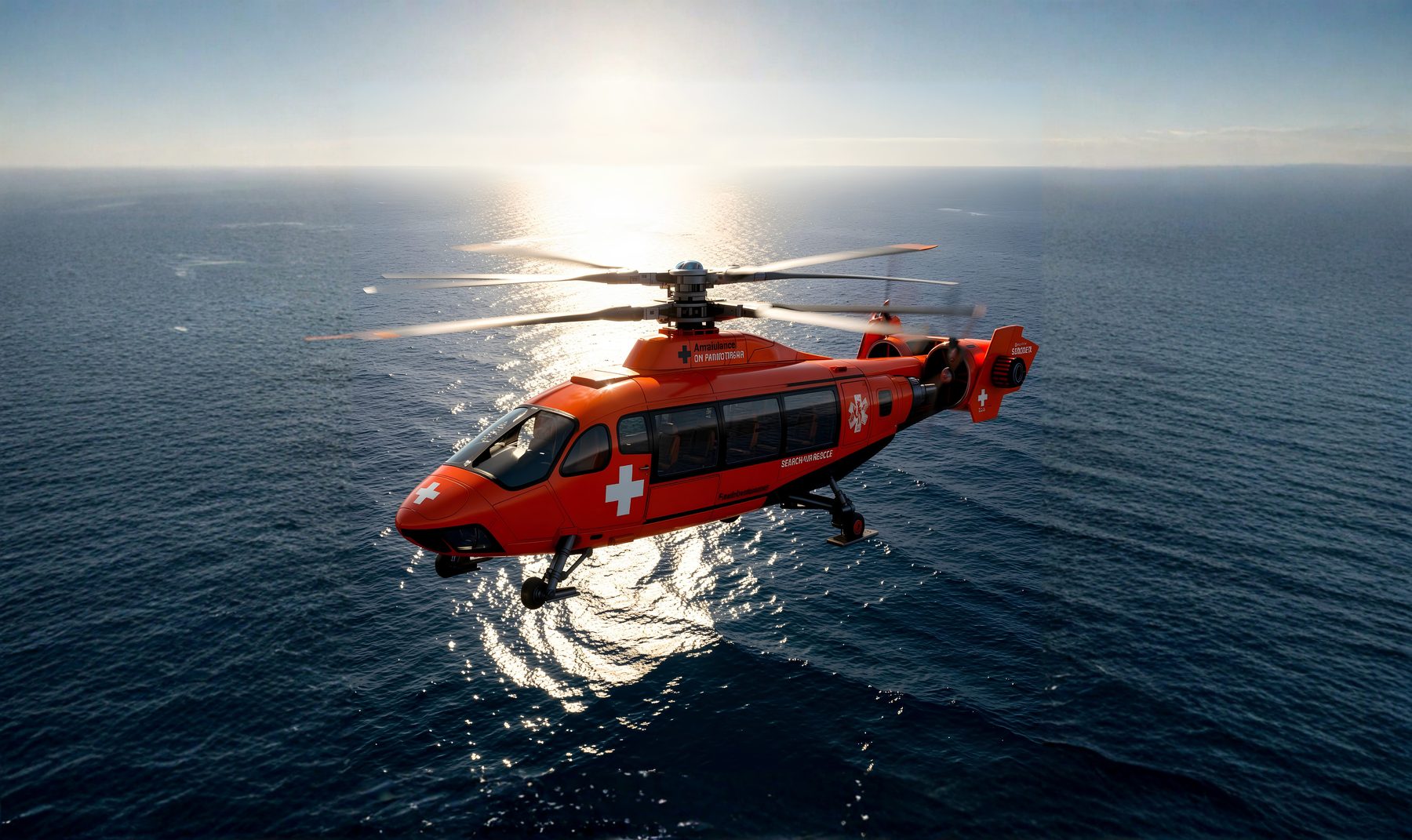
Where the money actually goes
An incumbent EMS helicopter costs between €2,000 and €4,500 per flight hour to operate. Strip that number apart and its components map directly onto the machine's architecture:
- Powertrain complexity. A powered main rotor demands a transmission engineered for continuous high torque; a tail rotor adds a second drive system running the length of the aircraft. Both carry mandatory overhaul cycles measured in thousands of hours — and priced in hundreds of thousands of euros.
- Fuel burn. Driving the rotor through every phase of flight is energetically expensive. The rotor generates lift and consumes power whether the mission needs vertical capability at that moment or not.
- Insurance and risk. The accident profile of conventional helicopters — tail rotor failures, vortex ring state, autorotation transitions under pressure — is priced into every policy and every operating approval.
- Crew and training overhead. Machines whose safe operation depends on perishable skills demand deep, recurrent and expensive training pipelines.
The result is an industry where, by some assessments, HEMS budgets routinely overrun by a third — and where coverage is rationed not by need but by what commissioners can fund.
Change the platform, change the equation
Now redesign the aircraft around the mission's actual requirements. Vertical capability is needed for minutes per mission — at the scene and at the hospital. Cruise, where the aircraft spends most of its life, needs stability, speed and efficiency, not a powered rotor. This is precisely the logic of the hybrid gyroplane-helicopter: power the rotor only when vertical flight is in use, and let it autorotate — freely, safely, efficiently — in cruise.
The consequences cascade through the cost structure. Lower transmission loads stretch maintenance intervals. Unpowered-rotor cruise cuts fuel burn by 35–40% per mission. An airframe with no tail rotor and no vortex ring state exposure re-prices the risk. Our Avectra 101 programme targets €320 per flight hour — a 94% reduction — not through operational austerity, but through architecture.
At €4,500 an hour, air ambulance is a scarce resource to be rationed. At €320 an hour, it is a public utility to be deployed.
What a 94% cost reduction actually buys
The interesting arithmetic is not the saving on existing missions — it is the missions that become possible:
- Coverage density. For the cost of one conventional helicopter base, a health system can operate a distributed network of aircraft with response times measured in single-digit minutes.
- Dispatch liberalisation. When the marginal cost of a flight falls by an order of magnitude, the threshold for launching falls with it — and marginal launches are where lives statistically hide.
- New markets. Health systems across the developing world, for whom helicopter EMS was never affordable, can commission aeromedical coverage for the first time.
- Resilient business models. Blending public contracts with private missions, industrial standby and telemedicine licensing produces revenue architecture that does not depend on charity tins.
The commissioning question
For commissioners and health systems, the question this raises is straightforward: if the dominant cost of aeromedical coverage is a function of aircraft architecture, and an alternative architecture exists with a credible certification pathway, what does responsible procurement look like over a ten-year horizon?
We think the answer will reshape the category — and we are building Aurenda to demonstrate it.
For commissioning and partnership discussions, contact the Aurenda team.