
Eyes in the Sky: How Unmanned Systems Are Reshaping Civil Security
The word "drone" still conjures either a hobbyist's quadcopter or a military silhouette. Between those images, largely unnoticed, a third category has matured: the civil-security UAS — and it is quietly becoming part of national infrastructure, as fundamental as the radar network or the coastguard fleet.
The persistence dividend
Crewed aircraft patrol; unmanned systems persist. The difference sounds semantic until you consider what seventeen-plus hours of continuous endurance — the class our Aeolus platform delivers with a 170 kg sensor payload — actually means operationally. A maritime authority can hold an entire coastline under unbroken observation. A border agency can watch a crossing corridor through the night, in weather that grounds helicopters. An energy operator can sweep hundreds of kilometres of pipeline in a single sortie.
Persistence changes the economics of attention. Incidents are no longer discovered after the fact and investigated; they are observed as they develop and interdicted.
Sensors are the real revolution
Airframes get the photographs, but the payload does the work. A modern integrated gimbal fuses four sensing modes into a single stabilised unit: high-resolution colour video, thermal imaging with operator-selectable palettes tuned for personnel or vehicle detection, laser range-finding for precise geo-location, and on-board processing that auto-tracks targets while displaying thermal and visual channels simultaneously.
The operational consequence: a single operator, seated in a ground control station, can find, identify, geo-locate and continuously track a target of interest day or night — and stream those coordinates in real time to the teams who need them. What once demanded a crewed aircraft, a trained observer and daylight now demands none of the three.
Persistence plus precision geo-location turns aerial surveillance from an activity into an infrastructure.
The missions defining the category
- Maritime surveillance. Persistent coastal and open-water monitoring — from search-and-rescue overwatch to fisheries enforcement and smuggling interdiction.
- Border security. Continuous corridor observation with real-time intelligence to ground units, replacing reactive patrols with anticipatory coverage.
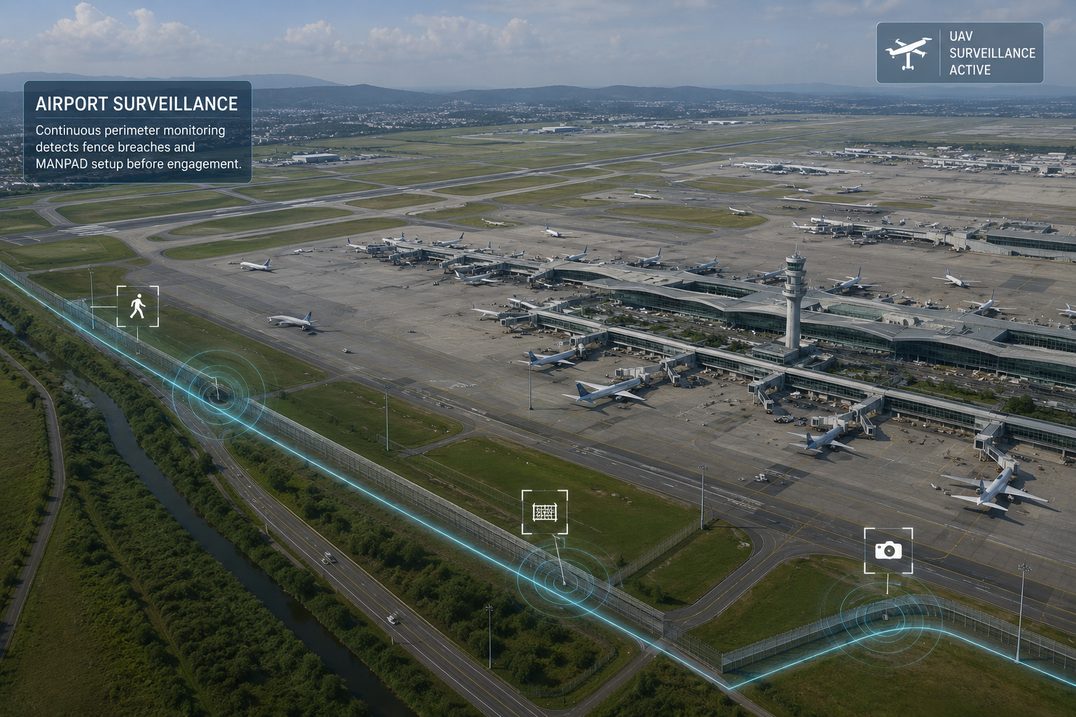
- Critical infrastructure. Powerline and pipeline overwatch, airport perimeter monitoring, facility protection — inspection schedules that would exhaust crewed budgets become routine.
- Disaster response. Immediate aerial assessment after floods, fires and earthquakes, when roads are gone and situational awareness is the scarcest resource — plus look-ahead for relief convoys moving through damaged terrain.
What operators should demand
As procurement expands from defence ministries to civil agencies, the evaluation criteria are maturing too. Four questions matter more than any brochure figure:
- Deployment speed. A system that needs a prepared site is a system that misses the incident. Transport-to-airborne in under fifteen minutes should be the benchmark.
- All-weather envelope. Civil emergencies do not schedule around icing limits. Look for flight-tested extremes — the Aeolus operates from −40°C to +55°C.
- Autonomy with accountability. Operator workload should be confined to mission decisions, with the system flying itself — and every feed captured, stored and replayable for evidential use.
- Fleet logistics. Shared airframes, control stations and training across variants determine the real ten-year cost far more than the sticker price.
Unmanned systems will not replace police officers, coastguards or linemen. What they replace is ignorance — the hours and square kilometres where no one could afford to look. That, more than any single mission, is why civil security is becoming the fastest-growing chapter of the unmanned aviation story.
Explore the Aeolus UAS platform or contact the Fixius team for procurement discussions.